
A Distributed Infrastructure Analysis of Instructional Discontinuity in U.S. Online Learning Environments
Introduction
Contemporary synchronous online learning environments are increasingly instantiated within multi-layered, cloud-native computational ecosystems whose operational resilience is intrinsically dependent upon hyperscale infrastructure providers. As a consequence, mid-session instructional discontinuities—manifesting as real-time media stream degradation, federated identity authentication failure, Learning Management System (LMS) inaccessibility, submission pipeline latency, and disruption of AI-mediated pedagogical tooling—are frequently symptomatic of upstream infrastructural instability rather than endpoint-level connectivity constraints.
A recent service-level disruption affecting Amazon Web Services (AWS) precipitated large-scale degradation across U.S.-based higher education delivery platforms, thereby interrupting proctored examinations, synchronous lecture dissemination, adaptive learning systems, institutional analytics environments, and distributed collaborative research interfaces. This incident underscores a structurally significant reality: contemporary digital pedagogy is no longer institutionally self-contained but is instead functionally contingent upon distributed third-party compute infrastructures whose reliability characteristics directly mediate instructional continuity.
This analysis interrogates the architectural and infrastructural dependencies through which AWS operates as a foundational computational substrate for digital education platforms and evaluates the mechanisms by which regionalized cloud service degradation propagates into application-layer instructional disruption.
AWS as Foundational Distributed Infrastructure in Educational Technology Ecosystems
Amazon Web Services (AWS) functions as a globally distributed virtualization and orchestration layer that abstracts storage, networking, and computational workloads into elastically provisioned managed services (e.g., EC2, S3, RDS, Lambda, IAM). Educational technology vendors and institutional IT departments increasingly externalize mission-critical operational dependencies to AWS in order to achieve elastic scalability, latency minimization, geographic redundancy, and infrastructural cost-efficiency within digitally mediated learning environments.
Within contemporary academic infrastructures, AWS commonly underpins:
- Learning Management Systems (LMS) and Student Information Systems (SIS)
- Real-time lecture capture, processing, and dissemination pipelines
- AI-driven assessment engines and adaptive instructional algorithms
- Containerized laboratory and simulation-based learning environments
- Federated identity, authentication, and authorization services
- Persistent storage for instructional artifacts and research datasets
- Predictive analytics frameworks for performance modeling
- Automated grading pipelines and academic integrity monitoring systems
- DevOps-enabled virtualized development environments for coding laboratories
Operationally, AWS CLOUD OUTAGEfunctions simultaneously as both the control plane and data plane for these educational services. Consequently, infrastructural degradation within cloud-managed Availability Zones may manifest as systemic academic service interruption analogous to electrical grid destabilization within physical institutional environments.
Infrastructure-Level Failure and Service Degradation
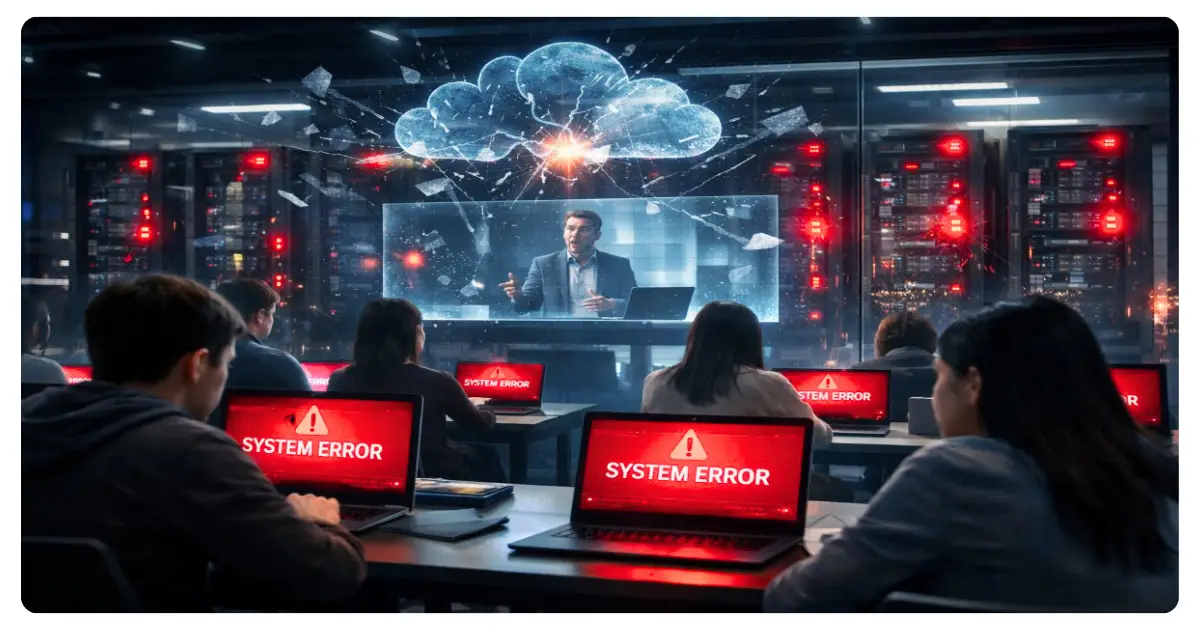
During the outage event, one or more AWS CLOUD OUTAGE regional Availability Zones experienced partial service unavailability, thereby impairing inter-service communication across dependent managed resources. Platform subsystems reliant upon object storage services (S3), container orchestration frameworks (EKS), compute virtualization (EC2), or identity validation mechanisms (IAM) encountered elevated latency thresholds, request timeout cascades, throughput degradation, and service-level API failure.
Application-layer manifestations included:
- LMS front-end inaccessibility resulting from backend dependency failure
- Federated authentication breakdown preventing authorized student access
- Instability within real-time lecture ingestion and playback pipelines
- Assignment upload persistence failure within distributed storage layers
- Ephemeral container collapse in cloud-hosted laboratory environments
- Interruption of AI-mediated tutoring, grading, and feedback services
- Loss of collaborative instructional session state
- Monitoring and attendance tracking system instability
Because numerous EdTech deployments utilize tightly coupled microservice architectures operating within single-region cloud configurations, localized infrastructural instability propagated into geographically distributed application-level outages affecting broad student populations.
Cascading Failure Propagation in Cloud-Native Academic Platforms
Virtual learning ecosystems are architected as distributed, service-oriented systems that externalize computational responsibilities to hyperscale infrastructure providers. Representative platform dependencies include:
- Stateless compute nodes for instructional session orchestration
- Managed relational and non-relational database clusters
- Content delivery networks (CDNs) for multimedia dissemination
- Event-driven messaging queues for submission workflows
- Containerized execution environments for coding laboratories
- Machine learning inference engines for adaptive pedagogy
Regional cloud service disruption may induce cascading failure across interdependent subsystems through mechanisms including:
- Control-plane inaccessibility disrupting orchestration frameworks
- Data-plane latency impairing distributed state synchronization
- Identity token validation failure across federated authentication layers
- Storage-layer write errors preventing instructional artifact persistence
- API throttling across interdependent service calls
- Load-balancing inconsistency across compute clusters
- Queue backlog accumulation in submission pipelines
Pedagogically, these infrastructural failure modes manifested as lecture discontinuity, assessment invalidation, submission pipeline failure, and desynchronization of collaborative instructional environments.
Observed Impact Across Educational Cohorts
The outage produced heterogeneous yet measurable disruption across secondary, undergraduate, graduate, and professional certification contexts, as well as within remote internship and workforce-aligned training initiatives.
Documented impacts included:
- Coursework loss resulting from storage persistence failure
- Inability to complete time-constrained assessments
- Attendance misclassification associated with session instability
- Disconnection from synchronous instructional interfaces
- Temporary loss of access to cloud-hosted development environments
- Delay in project-based internship participation
- AI-driven assessment workflow interruption
- Dashboard-level data synchronization inconsistency
AI-oriented training providers and coding bootcamps—whose platforms frequently rely upon containerized execution environments—were similarly affected, illustrating the systemic dependence of contemporary skills-based education on cloud reliability.
Implications for the Evolution of Cloud-Mediated Pedagogy
Digital education platforms are engineered for horizontal scalability, low-latency interaction, and globally distributed accessibility—properties rendered operationally viable through hyperscale cloud infrastructure. Instructional continuity is therefore increasingly coextensive with infrastructure-level service availability metrics.
Absent resilient cloud architectures:
- Synchronous instructional environments cannot maintain session coherence
- AI-assisted tutoring systems cannot execute inference workloads
- Simulation-based laboratories cannot instantiate ephemeral compute resources
- Academic records cannot be transactionally accessed in real time
- Virtualized internship environments cannot maintain container persistence
Consequently, educational outcomes are increasingly mediated by service-level objectives (SLOs), redundancy architectures, availability targets, and automated regional failover strategies implemented at the infrastructure layer.
Professional Implications for Emerging Technologists
From a workforce development standpoint, this outage foregrounds the necessity of cloud reliability competencies for careers in:
- Artificial Intelligence and Machine Learning Engineering
- Distributed Systems Architecture
- Backend and Platform Engineering
- Data Infrastructure Engineering
- Cybersecurity and Identity Management
- Cloud Engineering and DevOps
- Site Reliability Engineering (SRE)
Critical technical competencies now encompass:
- Multi-region active-active deployment strategies
- Disaster recovery frameworks aligned to RTO/RPO parameters
- Observability-driven incident response engineering
- Queue-based service decoupling and idempotent workflow design
- Circuit-breaker implementation and graceful degradation patterns
- Edge caching and automated failover orchestration
Engineers capable of designing fault-tolerant academic infrastructure via redundancy modeling, infrastructure-as-code deployment pipelines, and distributed failover mechanisms will be instrumental in sustaining the continuity of cloud-native educational delivery systems.
Conclusion
The AWS CLOUD OUTAGE represents not merely a transient service anomaly but an instructive case study in the infrastructural interdependencies that now underwrite contemporary education. As institutions continue to virtualize pedagogical delivery and integrate AI-enabled instructional modalities, hyperscale cloud platforms will remain foundational to academic system operability.
For students and emerging technologists, fluency in cloud architecture, distributed systems engineering, and reliability optimization is not simply advantageous but essential to the design and maintenance of resilient digital learning ecosystems upon which future educational access will depend.
Frequently Asked Questions (FAQs)
What constitutes an AWS Cloud Outage?
An AWS Cloud Outage refers to a disruption in one or more managed infrastructure services or Availability Zones that inhibits the normal operation of dependent digital platforms.
Why do online instructional platforms fail during an AWS Cloud Outage?
Online learning systems rely on AWS-hosted computational and storage infrastructure for authentication, content delivery, and data persistence. Service disruption inhibits platform functionality during AWS Cloud Outage events.
Can an AWS Cloud Outage invalidate online examinations?
Yes. Infrastructure-level service instability during an AWS Cloud Outage may prevent assessment submission or authentication, thereby invalidating exam sessions.
How may institutions mitigate AWS Cloud Outage disruptions?
Through multi-region deployment strategies, redundancy architectures, and disaster recovery planning aligned with reliability engineering practices to reduce AWS Cloud Outage impact.
Why is cloud computing literacy important during an AWS Cloud Outage?
Understanding distributed infrastructure prepares students for careers in AI, DevOps, cybersecurity, and distributed systems engineering in environments vulnerable to AWS Cloud Outage conditions.