Reusable Launch Vehicle Ecosystems as Structural Catalysts for Advanced Artificial Intelligence Career Pathways
A Systems-Theoretic Examination of AI-Integrated Launch Operations, Orbital Infrastructures, and Global Workforce Formation
Introduction: Launch Architectures as AI-Intensive Cyber-Physical Systems

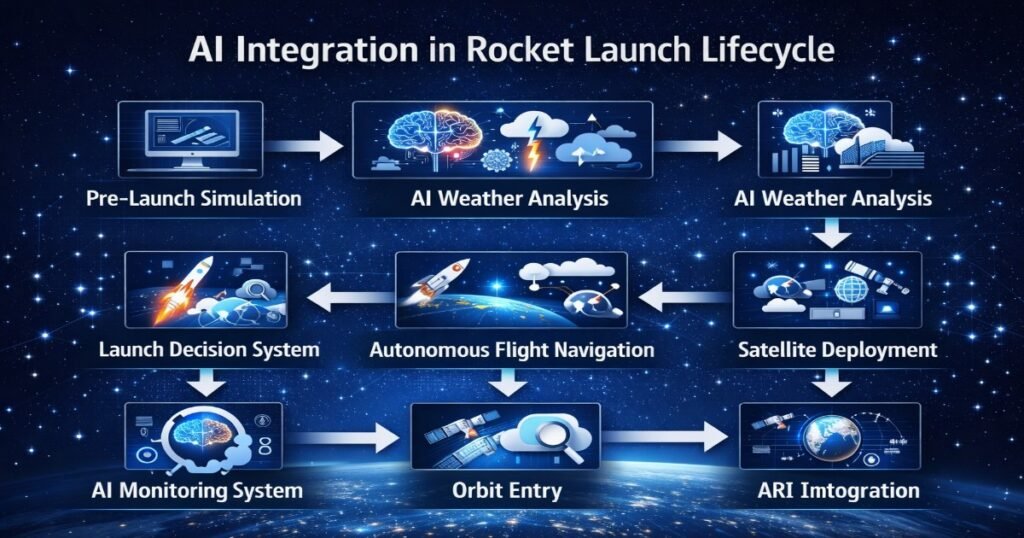
Contemporary orbital launch systems are more accurately interpreted as tightly coupled cyber-physical infrastructures in which Artificial Intelligence (AI) mediates high-stakes decision-making processes across mission planning, ascent-phase trajectory regulation, in-orbit constellation governance, and precision recovery operations. Reusable Launch Vehicle (RLV) paradigms—most prominently operationalized by SpaceX—are structurally predicated upon machine learning–enabled prognostics, autonomy-centered control regimes, probabilistic risk quantification, and perception-driven landing subsystems.
Across the mission lifecycle, AI-enabled computational layers are routinely deployed to:
- Execute prognostics and health management (PHM) for propulsion subsystems
- Coordinate satellite separation within multi-objective deployment frameworks
- Model atmospheric turbulence and heliophysical variability
- Facilitate closed-loop autonomous navigation under stochastic perturbations
- Optimize propellant utilization through adaptive trajectory inference
- Perform real-time orbital debris detection and classification
- Identify telemetry anomalies via statistical learning pipelines
- Regulate constellation traffic within congested orbital regimes
- Forecast communication link degradation
- Enable onboard edge inference for in-situ autonomy
The systemic incorporation of AI within launch and downstream satellite infrastructures has substantively expanded globally distributed employment pathways for machine learning engineers, autonomy specialists, aerospace software developers, geospatial intelligence analysts, and mission operations data scientists.
Participation within these emergent labor markets is not exclusively constrained to aerospace-trained professionals. Individuals with demonstrable expertise in computational intelligence, control theory, statistical learning, robotics, and distributed systems engineering are increasingly positioned to contribute to space-technology value chains via AI-mediated roles.
Section I: AI Integration Across Launch Vehicle Operational Phases
Modern launch ecosystems embed AI across mission-critical phases to enhance reliability, resilience, and adaptive capacity.
I.1 Predictive Launch Readiness and Fault Prognostics
Supervised, semi-supervised, and unsupervised learning algorithms ingest high-frequency telemetry streams—including thermodynamic gradients, structural vibration signatures, turbopump performance indicators, avionics stability metrics, and power-distribution fluctuations—to probabilistically anticipate subsystem failure states prior to ignition. Bayesian inference and ensemble modeling techniques are frequently employed to characterize epistemic uncertainty.
I.2 Autonomous Guidance, Navigation, and Control (GN&C)
Reinforcement learning–based control policies facilitate dynamic trajectory correction in response to atmospheric perturbations, thereby maximizing ascent efficiency while maintaining structural integrity constraints. Adaptive control regimes enable real-time compensation under non-deterministic environmental conditions.
I.3 Vision-Guided Booster Recovery
Computer vision pipelines—leveraging convolutional neural networks (CNNs) and transformer-based perception architectures—support booster re-entry and autonomous landing through real-time platform detection, pose estimation, descent optimization, and lateral drift mitigation.
I.4 Orbital Debris Detection and Collision Avoidance
Deep learning classifiers applied to multispectral and hyperspectral imagery facilitate debris segmentation, collision-risk estimation, and trajectory recalibration for both launch vehicles and deployed satellites.
I.5 Telemetry Anomaly Detection
Out-of-distribution telemetry signatures are identified through autoencoder-based models and isolation forests to mitigate cascading subsystem degradation.
Section II: AI-Mediated Occupational Specializations in Space Technology Ecosystems
The commercialization of launch services has generated demand for the following advanced professional roles:
- Aerospace AI Data Scientist
- Autonomous Systems Engineer
- Remote Sensing and Geospatial Intelligence Analyst
- Machine Learning Engineer (GN&C Optimization)
- Mission Simulation Developer
- Computer Vision Specialist (Re-entry and Docking)
- Predictive Maintenance Analyst (PHM Systems)
- Satellite Telemetry Data Engineer
- Deep Learning Researcher (Orbital Mechanics)
- Edge AI Systems Architect for In-Orbit Processing
- Aerospace MLOps Engineer
- Constellation Traffic Optimization Analyst
- Mission Operations Data Engineer
- Space Communications AI Specialist
- Onboard Autonomy Software Developer
These competencies are concurrently sought by organizations operating across Earth observation, precision agriculture, telecommunications infrastructure, maritime surveillance, environmental monitoring, and disaster-resilience analytics.
Section III: Computational Entry Pathways for Indian Professionals
Consider the professional trajectory of a physics graduate from Madhya Pradesh who, through open computational repositories, developed competencies in Python-based machine learning and geospatial image analysis. By implementing convolutional architectures for land-use classification, floodplain detection, and crop-stress identification using multispectral satellite datasets, the individual secured internship placement within an Earth-observation startup.
Subsequent professional engagement included:
- Flood-risk forecasting via multispectral analytics
- Agricultural yield estimation through temporal imagery
- Climate variability monitoring
- Environmental change detection using longitudinal datasets
- Urban land-surface temperature mapping
This trajectory illustrates the permeability of space-AI career pathways to computationally trained professionals irrespective of formal aerospace specialization.
Section IV: Competency Architecture for AI Careers in the Space Sector
Technical Competencies
- Python-Based Scientific Computing
- Statistical Machine Learning
- Deep Neural Architectures
- Computer Vision and Image Segmentation
- Cloud-Native Data Engineering Pipelines
- Robotics and Control Systems Theory
- Remote Sensing Analytics
- Time-Series Modeling
- Distributed Systems Engineering
Cognitive and Collaborative Competencies
- Systems Thinking
- Quantitative Reasoning
- Interdisciplinary Collaboration
- Research Methodology
- Adaptive Problem Solving
- Technical Communication
Section V: Structured Entry Pathway into AI-Enabled Space Careers
- Develop foundational programming proficiency in Python
- Acquire fluency in statistical learning theory
- Implement domain-relevant models using satellite datasets
- Construct a reproducible research portfolio
- Pursue internships within space-technology startups
- Engage in open-source aerospace analytics initiatives
- Deploy geospatial deep learning models
- Apply to telemetry- and autonomy-oriented roles
- Acquire familiarity with cloud-based MLOps pipelines
- Specialize in remote sensing or GN&C analytics
Section VI: Downstream Industries Recruiting Space-AI Specialists
Professionals with aerospace-AI competencies are recruited by:
- Commercial Launch Startups
- Satellite Communications Firms
- Defense Technology Units
- Climate and Environmental Research Institutes
- Precision Agriculture Platforms
- Navigation and Geolocation Providers
- Disaster Risk Management Agencies
- Urban Infrastructure Planning Organizations
- Oceanographic Monitoring Services
Section VII: Data Engineering and MLOps for Space Missions
Deployment of AI within space ecosystems necessitates robust pipelines encompassing telemetry ingestion, preprocessing, model training, validation, and continuous monitoring. Practitioners should demonstrate familiarity with:
- Satellite telemetry ingestion frameworks
- Geospatial feature engineering
- Model versioning and experiment tracking
- Edge deployment for in-orbit inference
- Continuous integration for mission analytics
Section VIII: Ethical and Regulatory Considerations
AI-enabled space systems must adhere to evolving governance frameworks addressing:
- Orbital congestion mitigation
- Data privacy in Earth observation
- Dual-use technological risk
- Environmental sustainability of launch operations
- Responsible deployment of autonomous control systems
Section IX: Emerging Research Trajectories
Prominent research directions include:
- Federated learning across satellite constellations
- Onboard reinforcement learning for adaptive navigation
- Space-weather predictive analytics
- Multimodal sensor fusion for debris detection
- Autonomous docking and rendezvous optimization
These domains are anticipated to generate novel doctoral-level research opportunities over the coming decade.
FAQs
Is an aerospace degree mandatory for employment in the space sector?
No. AI specialists are required for software engineering, data analytics, and autonomous systems development.
Is AI operationally embedded within launch missions?
Yes. AI supports navigation, safety monitoring, predictive maintenance, anomaly detection, and mission optimization.
Which programming language is most suitable for aerospace AI roles?
Python remains the predominant language for AI-driven analytics and model deployment.
Are there space-AI opportunities within India?
Yes. Numerous startups are engaged in Earth observation and satellite data analytics.
Can early-stage learners begin preparation for this field?
Yes. Foundational programming and introductory machine learning constitute appropriate entry points.
Conclusion: The AI–Space Nexus as a Future Labor Multiplier
Reusable launch architectures constitute computationally intensive ecosystems that are generating new labor markets predicated upon Artificial Intelligence, autonomy, and advanced analytics. Professionals who initiate AI competency acquisition today may contribute to satellite mission analytics, autonomous navigation frameworks, climate intelligence platforms, robotic space-exploration systems, and in-orbit data-processing pipelines.
Actionable CTA
Initiate your transition into the aerospace-AI domain by mastering Python and statistical machine learning. Explore advanced, practitioner-oriented career resources on AIJobFuture.com to align technical competencies with globally competitive space-technology roles.