
A Computational Paradigm for the Robust Identification of Martian Biosignatures
Within contemporary planetary science and astrobiology, the reliable identification of biosignatures beyond Earth constitutes one of the most consequential scientific objectives of the twenty-first century. Increasingly, this objective is no longer pursued exclusively through conventional spectroscopic interpretation or laboratory-based geochemical analysis, but through the integration of Artificial Intelligence (AI) architectures capable of interrogating high-dimensional datasets derived from Martian regolith and atmospheric systems.
AI-enabled analytical frameworks are now deployed to detect organic molecular signatures on Mars, thereby enhancing our capacity to empirically interrogate one of the most profound scientific questions in astrobiology:
👉 Does life exist, or has it previously existed, beyond Earth?
The contemporary search for Martian biosignatures has consequently transitioned from a predominantly observational paradigm to a computationally mediated investigative framework in which machine learning algorithms extract statistically significant chemical correlations embedded within rover-acquired mineralogical and atmospheric datasets. This transition represents a methodological inflection point in astrobiological inquiry, combining in situ planetary exploration with high-throughput computational inference.
Examine how Artificial Intelligence is enabling the detection of organic molecules on Mars. Understand how AI-driven astrobiological analysis is accelerating biosignature identification and expanding interdisciplinary research in planetary science and computational geochemistry.
🌄 [Insert Infographic Here]
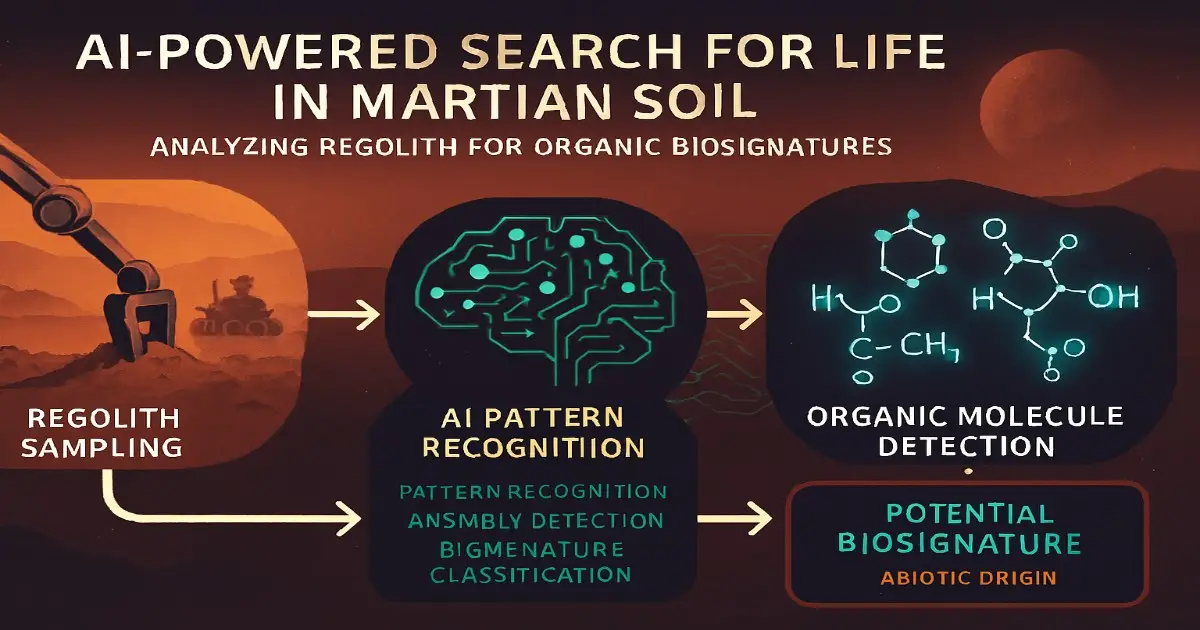
Visual Suggestion: Infographic illustrating AI-mediated analysis of Martian regolith for organic biosignatures.
Alt Text: Artificial Intelligence analysing Martian soil datasets to identify carbon-based organic compounds.
🚀 Biochemical and Planetary Context of Organic Molecules on Mars Detection
Prior to evaluating the computational contribution of AI systems, it is necessary to contextualise the astrobiological relevance of organic molecular detection within extraterrestrial environments.
Organic Molecules in a Planetary Science Framework
Organic molecules are carbon-containing chemical structures that constitute the fundamental molecular architecture of terrestrial biological systems, including:
- Amino acids
- Proteins
- Carbohydrates
- Nucleic acid precursors (DNA/RNA)
- Hydrocarbon-based lipid analogues
Within astrobiology, the detection of such carbon-based compounds is frequently interpreted as a potential indicator of prebiotic or biogenic processes. Their presence may suggest the historical viability of microbial ecosystems under previously habitable environmental conditions, particularly during geological epochs in which Mars is hypothesised to have sustained surface hydrological systems and a comparatively denser atmosphere.
The identification of trace organic compounds on Mars through rover-based spectroscopic instrumentation has generated sustained scientific interest. However, accurate molecular discrimination remains constrained by several planetary factors, including:
- Ionising radiation–induced molecular degradation
- Aeolian sedimentary redistribution
- Abiotic geochemical synthesis pathways
- Ultraviolet photolytic decomposition of carbon compounds
- Oxidative soil chemistry mediated by perchlorates
Collectively, these environmental confounders complicate the discrimination between biogenic and abiotic organic synthesis pathways, thereby necessitating advanced computational methodologies capable of probabilistic classification and multi-variable pattern inference.
🤖 Machine Learning–Driven Detection of Organic Molecules in Martian Regolith

Artificial Intelligence systems are currently employed to process extensive datasets acquired through rover instrumentation, including:
- Mineralogical composition spectra
- Atmospheric chemical signatures
- Raman spectroscopic outputs
- Radiation exposure indices
- Thermal variability metrics
- Surface oxidation patterns
- Laser-induced breakdown spectroscopy (LIBS) datasets
Historically, such datasets required prolonged manual interpretation by planetary geochemists. Contemporary machine learning architectures now enable automated pattern recognition across multidimensional chemical datasets with substantially reduced analytical latency.
AI methodologies facilitate:
Detection of Latent Molecular Correlations
Machine learning algorithms identify statistically significant micro-scale chemical correlations indicative of preserved organic residues, even in low signal-to-noise environments.
Probabilistic Biosignature Inference
Computational models compare Martian geochemical data with terrestrial biological analogues to assess potential biogenic origins through supervised and unsupervised learning paradigms.
High-Throughput Analytical Processing
AI-assisted analytical systems evaluate millions of spectrometric signals within seconds, enabling rapid prioritisation of high-interest samples for targeted investigation.
Mitigation of Analytical False Positives
Machine learning classifiers can distinguish between:
- Biogenic organic synthesis
- Abiotic geochemical formation
- Environmentally induced chemical transformations
- Post-depositional alteration processes
Such differentiation substantially enhances interpretative reliability and reduces mission-level analytical uncertainty.
🧠 Integration of AI in Planetary Astrobiological Modelling
AI-based analytical systems deployed in Martian exploratory missions are trained using:
- Terrestrial microbial genomic databases
- Simulated prebiotic reaction pathways
- Radiation exposure modelling datasets
- Planetary environmental evolution simulations
- Geological stratification analyses
- Comparative sedimentary records from terrestrial extremophilic environments
Through deep learning frameworks, AI models reconstruct:
- Ancient Martian climatic regimes
- Hydrological distribution networks
- Hypothetical microbial ecological niches
- Surface geochemical evolutionary pathways
- Long-term atmospheric dissipation processes
Consequently, AI functions not solely as a detection mechanism, but as a predictive modelling system capable of evaluating the historical habitability of extraterrestrial environments across geological timescales.
🇮🇳 Indian Participation in AI-Mediated Planetary Research
The emergence of AI-mediated astrobiological analysis is generating interdisciplinary academic opportunities for students in emerging scientific communities, including India.
For instance, Ramesh, a science educator from Madhya Pradesh, initiated independent study in machine learning through open-access computational courses. Motivated by planetary exploration research, he began simulating chemical classification models using Python-based frameworks for spectral data interpretation.
Within a six-month period, he:
- Developed a supervised learning model for organic compound classification
- Integrated AI-based chemical analysis into classroom instruction
- Established an introductory online course in computational space science
- Initiated student-led projects in planetary dataset modelling
This example illustrates the increasing accessibility of AI-driven research pathways for students from non-metropolitan regions and underscores the democratisation of computational science education.
📊 Scientific Implications of Confirmed Organic Molecule Detection
Should AI-mediated analyses confirm the biological origin of Martian organic compounds, the implications would include:
- Evidence of ancient microbial ecosystems
- Validation of extraterrestrial biological potential
- Feasibility assessments for long-duration human planetary habitation
- Reconstruction of historically habitable environments
- Re-evaluation of planetary protection frameworks
Potential interdisciplinary impacts include:
| Sector | Impact |
|---|---|
| Space Exploration | Enhanced biosignature detection systems |
| Medicine | Comparative microbial studies |
| AI Research | Planetary predictive modelling |
| Education | Expansion of STEM disciplines |
| Economy | Aerospace technology growth |
| Robotics | Intelligent exploration platforms |
| Climate Science | Comparative planetary climate modelling |
🛠️ Academic Trajectory Toward AI-Enabled Planetary Research
Students and professionals seeking engagement in AI-driven planetary research may consider the following academic pathway:
Step 1: Computational Programming Foundations
- Python
- Scientific data processing tools
- Linear algebra fundamentals
Step 2: Machine Learning Methodologies
- Pattern recognition algorithms
- Predictive modelling systems
- Statistical inference techniques
Step 3: Planetary Science Fundamentals
- Planetary geology
- Atmospheric chemistry
- Astrobiology
- Remote sensing principles
Step 4: Research-Oriented Projects
- Soil composition modelling
- Climate simulation frameworks
- Chemical pattern classification
- Planetary surface mapping
- Spectral data interpretation
Step 5: Research Internships
- Space research centres
- AI analytics laboratories
- Remote sensing organisations
- Aerospace computational units
- University-led astrobiology laboratories
🏁 Conclusion: AI as a Paradigm Shift in Planetary Discovery
Artificial Intelligence is fundamentally transforming the methodological landscape of planetary exploration. The AI-assisted detection of organic molecules on Mars represents not merely a technological advancement, but a paradigm shift in the empirical investigation of extraterrestrial habitability.
Future discoveries regarding Martian biosignatures may emerge not exclusively from conventional laboratory environments, but from algorithmic systems developed by emerging researchers within computational science communities.
👉 Actionable Next Steps
Interested in pursuing advanced research in AI-enabled space exploration?
- Explore interdisciplinary AI and planetary science programmes
- Download the AI Space Research Roadmap
- Share this article with aspiring computational scientists
🚀 Initiate your research trajectory today — the future of planetary exploration may depend upon it.