Advancing Astronomical Literacy Through Artificial Intelligence–Driven STEM Education
Solar Eclipse 2026 represents a scientifically significant astronomical event and a transformative pedagogical opportunity. Discover how AI-enhanced learning systems are redefining STEM education across America through Solar Eclipse 2026.
Introduction
Solar Eclipse 2026 is anticipated to constitute one of the most pedagogically consequential astronomical phenomena for students, educators, academic researchers, and technology practitioners throughout the United States. Although solar eclipses have historically captivated both scientific inquiry and public imagination, Solar Eclipse 2026 introduces an interdisciplinary educational paradigm that integrates observational astrophysics with artificial intelligence–mediated learning environments.
Contemporary STEM education in the United States has undergone accelerated evolution as a result of AI-driven computational frameworks, immersive simulation platforms, and real-time analytical systems. With Solar Eclipse 2026 approaching, AI-enabled educational infrastructures are facilitating a more sophisticated comprehension of astronomical phenomena through predictive modelling, spatial visualisation, and algorithmically enhanced data interpretation. This celestial event therefore, serves not merely as an observational occurrence but as a real-world context for applying artificial intelligence methodologies across domains such as astrophysics, atmospheric science, orbital mechanics, and satellite-based analytics.
Solar Eclipse 2026 consequently presents a meaningful opportunity for academic institutions to reconcile traditional instructional methodologies with emerging digital pedagogies grounded in artificial intelligence.
Understanding Solar Eclipse 2026
Solar Eclipse 2026 will occur when the Moon’s orbital trajectory aligns between the Earth and the Sun, thereby occluding solar radiation either partially or totally depending upon geographic location. During Solar Eclipse, observers across multiple regions will experience differential light attenuation and potential solar corona visibility, creating an empirically valuable context for both scientific observation and pedagogical experimentation.
From an educational standpoint, Solar Eclipse enables students throughout the United States to engage in experiential and data-informed learning processes. Rather than relying exclusively on static theoretical representations, learners may employ AI-driven simulations to investigate eclipse mechanics, gravitational interactions, heliophysical radiation dynamics, and planetary orbital behavior in real time.
AI-based visualization platforms further elucidate the astrophysical mechanisms underlying Solar Eclipse 2026 and its broader environmental implications.
Significance of Solar Eclipse 2026 for STEM Education in the United States
Solar Eclipse 2026 extends beyond its classification as an astronomical phenomenon and instead functions as an instructional gateway to contemporary STEM learning methodologies.
Real-Time Scientific Learning
Solar Eclipse facilitates the empirical observation of astrophysical processes in situ. AI-powered analytical platforms enable real-time eclipse trajectory mapping, three-dimensional celestial modelling, and predictive orbital simulations that enhance comprehension of planetary motion and geometric alignment.
Data-Driven Educational Frameworks
During a Solar Eclipse, artificial intelligence systems may be utilised to collect and interpret atmospheric thermal variation, solar irradiance fluctuations, and photometric intensity shifts. Such data-driven inquiry enables students to recognize the centrality of machine learning and computational analytics in contemporary space science and environmental monitoring.
Enhanced Cognitive Engagement
AI-mediated simulations associated with Solar Eclipse facilitate the transformation of abstract theoretical constructs into immersive visualisations, thereby enhancing cognitive engagement within STEM curricula.
Project-Based Computational Inquiry
Solar Eclipse provides a context for project-based AI learning in which students may operationalize predictive algorithms to investigate astrophysical and environmental phenomena.
The Role of Artificial Intelligence in Solar Eclipse 2026 Learning Environments
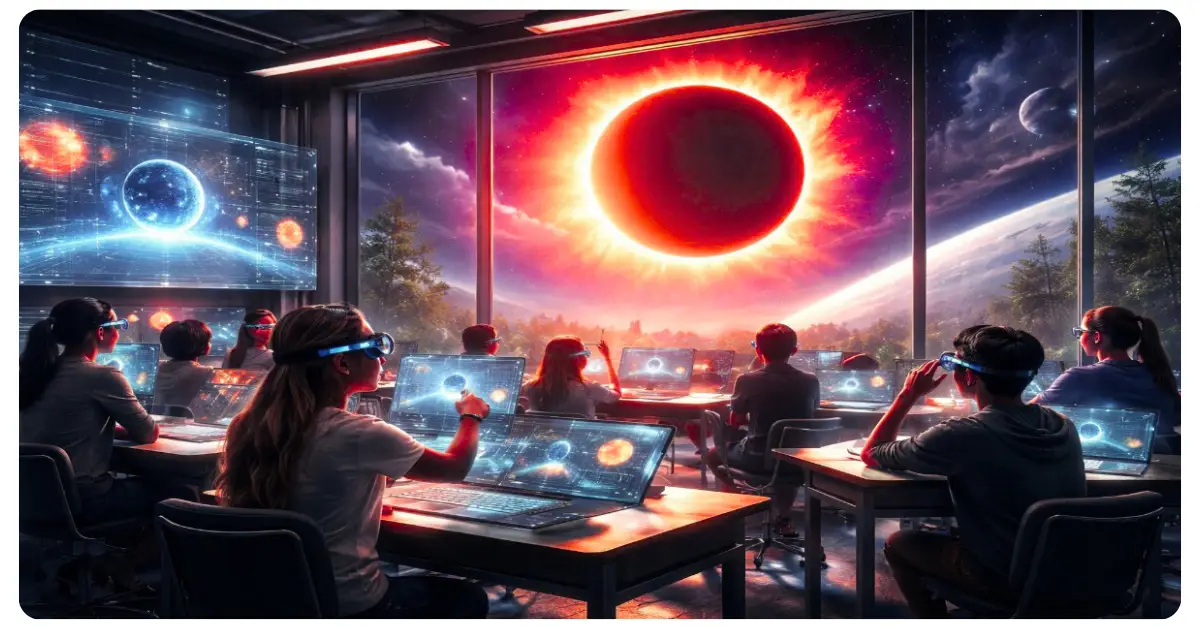
Artificial intelligence is fundamentally reconfiguring the manner in which learners interact with astronomical phenomena such as Solar Eclipse through predictive analytics and interactive simulation architectures.
AI-Based Simulations
AI-enabled platforms may digitally reconstruct Solar Eclipse within classroom environments, thereby permitting geographically independent eclipse visualization and analysis.
Machine Learning Applications in Astronomy
Machine learning algorithms can model eclipse chronology, duration metrics, and solar radiation variability during a Solar Eclipse. This facilitates the pedagogical integration of predictive modeling within astronomy education.
Augmented and Virtual Reality Integration
AI-powered AR and VR systems enable students who are unable to directly observe a Solar Eclipse to participate in immersive virtual observation experiences.
Intelligent Comparative Analytics
Students may utilize AI-based analytical frameworks to conduct comparative assessments between Solar Eclipse and prior astronomical events.
Emerging Career Pathways Inspired by Solar Eclipse 2026
Solar Eclipse may serve as a catalyst for student engagement with AI-integrated STEM career pathways, including:
- Space Data Analyst
- Artificial Intelligence Research Scientist
- Astrophysical Systems Engineer
- Satellite Communications Developer
- Machine Learning Specialist in Space Science
- Remote Sensing Analyst
- Aerospace Software Architect
Engagement with Solar Eclipse through AI-mediated platforms may inspire participation in advanced scientific and technological research domains.
Solar Eclipse 2026 and Future AI Education Trends
Academic institutions within the United States are increasingly incorporating artificial intelligence into STEM curricula in order to cultivate experiential learning ecosystems. Solar Eclipse provides a uniquely situated real-world event through which learners may develop competencies in:
- Predictive computational analytics
- Orbital simulation modeling
- Atmospheric data interpretation
- AI-driven research methodologies
- Real-time machine learning applications
The integration of Solar Eclipse within AI-enhanced instructional frameworks may therefore support workforce preparedness in robotics, aerospace engineering, computational science, and artificial intelligence.
Institutional Applications of Solar Eclipse 2026 for AI-Based Learning
Computational Classroom Projects
Students may construct AI models to forecast photometric variation and shadow displacement during a Solar Eclipse.
Empirical Data Acquisition Activities
Educators may assign observational research projects wherein students collect thermal and luminance data during Solar eclipses for subsequent AI-assisted analysis.
Virtual Observational Laboratories
AI-driven virtual laboratories may be employed to simulate Solar Eclipse observational environments for geographically remote learners.
STEM Research Workshops
Institutions may develop Solar eclipse–focused workshops emphasising predictive modelling and astronomical data analytics.
Safety Awareness During Solar Eclipse 2026 Observation
Educational institutions must additionally prioritize ocular safety protocols during Solar Eclipse 2026 observation. AI-enabled mobile platforms may disseminate real-time safety advisories, eclipse chronology alerts, and evidence-based viewing guidelines.
Integrating safety instruction with AI-based observation ensures responsible scientific engagement.
Conclusion
Solar eclipse represents a significant interdisciplinary opportunity to synthesise astronomical observation with artificial Intelligence-driven pedagogical innovation throughout the United States. As AI continues to redefine STEM learning ecosystems, Solar Eclipse may function as a formative educational milestone capable of motivating student participation in science, engineering, and computational research.
Through the integration of AI-enabled analytical infrastructures, Solar Eclipse may facilitate the transition from traditional didactic instruction toward immersive, data-centric educational experiences.
Frequently Asked Questions (FAQs)
What is Solar Eclipse 2026?
Solar Eclipse 2026 is an astronomical alignment event in which the Moon occludes solar radiation partially or totally, offering a valuable instructional context for STEM learning.
How can Solar Eclipse support AI education?
Solar Eclipse enables students to employ AI-based simulation, predictive modelling, and computational analysis within space science learning environments.
Why is Solar Eclipse 2026 important for U.S. students?
Solar eclipse provides an experiential observational framework augmented by artificial intelligence–driven analytical tools.
Can Solar Eclipse 2026 inspire STEM careers?
Solar Eclipse 2026 may encourage student engagement with professional pathways in artificial intelligence, data science, and aerospace technology.
How can schools use Solar Eclipse 2026 for learning?
Schools may integrate AI-enabled simulation and observational analysis of Solar Eclipse 2026 into STEM instructional programs.